Monday, April 24, 2006

Woman Inserting A Tampon Voyeur


In the minds of the Middle Ages the known world was inhabited by corporeal beings, tangible and susceptible of knowledge, while the unknown world was full of inexplicable nature beings. Reality and fantasy are confused in the collective consciousness through the teratological iconography of sacred sites (gargoyles on the walls of churches and evil beings in the capitals) that reaffirmed the existence of monstrous beings causing all unexplained phenomena from a rational point of view. Among the fantastic creatures that filled the public mind in Europe at the end of the Middle Ages include in particular those relating to vampires, werewolves and demonic beings. What is the vampiric imagery of the Middle Ages?

We have seen in previous posts that the first references to lustful beings who feed on human blood arise in the classical tradition of hand harpies, strigose and empusa, however, will be in the late Middle Ages when these myths are central in the collective consciousness under the name "vampire." Vampire legends, especially entrenched in Eastern Europe, conceived of vampires as undead creatures that feed on the blood of the living to remain in a state of immortality until the end of time. Medieval iconography looming vampire vampires as monstrous looking beings, repulsive and foul breath, until the literature of the last decades of the eighteenth century began to wrap the figure of the vampire with a halo of romance decadendente you see in nature a compendium of erotic and pleasure.

The Gothic tale Wake Not the Dead Johann Ludwick Tieck published in 1800 recovered the figure of the vampire legends of the dark Middle Ages and laid the foundations for the new image of the moody and seductive vampire who popularized a few years later Polidori in the story the Vampire (1816), James Rymer in Varney the Vampire (1845) and Sheridan Le Fanu especially who, depressed after the untimely death of his wife, published in 1855 the magnificent work Camilla, showing for the first time the figure of the vampire woman, sensual and evocative, breaking the anthropomorphic image of the harpies, strigose and empusa for closer to the figure of Lilith. When Bram Stoker published Dracula (1888) the presence of the modern vampire and is a constant in the Gothic novel.

What is the first historical reference for vampire legends? Historical sources tell us of the existence of a noble family who managed to control large lordships in a central region of Transylvania, the Bathory family, one of whose ancestors had fought against the Turks along the voivod Vlad Tepes (historical figure who inspired the character Dracula of Bram Stoker's novel). In the seventeenth century one of the women of the lineage, Erzsébet Bathory, plunged into the terror of the peasants of the Transylvanian territories because of their inordinate taste the blood of young maidens to the point of being known by the nickname "The Blood Countess."

Historical sources show us Erzsebet Bathory as a woman so obsessed with her public image had no qualms about changing your hairstyle and clothing up to six times a day and spend hours looking in the mirror of the first signs of aging. After the death of her husband, Ferencz Nadasdy, Erzsébet discovered the rejuvenating power of course blood as follows. One of his daughters was combing his hair when he accidentally pulled a small tuft causing outrage in the countess who slapped the maid reacted so strongly that caused a slight nosebleed. The blood came out and went for somewhere in the skin of the countess, who thought he noticed an amazing improvement of the skin where it had landed a drop of blood. From then on he devoted much of his life to his favorite pastime: taking blood baths to prevent skin aging.

With the help of a blacksmith well paid and frightened, Countess secretly forged the tool necessary for this hobby: a cylindrical cage of iron sheets held together by rings and whose interior was fitted with sharp spikes. When the time and always night, beginning the bloody pastime of the countess. Dork assistant was descending the basement stairs to a completely naked young girl that dragged the heavy hair and introduced into the cage that was elevated immediately to the vaulted ceiling with a pulley. At that moment it appeared the Countess Elizabeth, dressed in white linen, was introduced into a small tub beneath the cage. Taking a poker, dork began to beat the prisoner who, in his movements back, fell violently against the spikes surrounding the interior of the cage making his blood flow into the tub for the Contessa. When the girl was bleeding to death, the maid Katelin washed the basement traces of blood and Countess gathered the bloody hand folds of her dress, ordered that light the way and returned to his room.

But time passed and the aged countess. Thinking that the cause of aging is due to the plebeian origin of their victims, Erzsébet castle began to invite the daughters of the lower nobility, but in that decision found the limits of the feudal system. Himself king of Hungary, Matthias Habsburg ordered a halt to the vagaries of the Countess and conduct a trial to which he refused to attend Erzsébet invoking their noble privileges. Her maids were tortured and burned. The Countess was sentenced to live in a walled room of his castle in which the only outside contact was a small hole through which food is passed. The Blood Countess died in 1614.

Despite the relevance of Erzsebet Bathory reached in the seventeenth century, the character that has permeated the vampire legends is Vlad Tepes, the legendary Bram Stoker's Dracula, which I will discuss in subsequent entries.

Monday, April 17, 2006

How To Build A Model Roller Coaster

vampire Lilith and demonology.

iconographic evolution of Lilith from the Sumerian reliefs to the biblical writings are characterized by sequential acquisition of characteristics lascivious night and bloody, culminating with the image of the Hebrew Lilith turned into a demon that feeds on the blood of newborns. Lilith's attraction for the blood eventually became their defining trait, and the vampiric imagery of the Middle Ages to the Sumerian goddess assimilated with vampiric beings to the point of being considered the first female vampire. What is the mythological origin of vampires and maintain relationship with Lilith?
The first references to lewd women who feed on human blood appear in the classical tradition. Harpies relatives, women with bird body and sharp claws to abduct newborn of which we speak to each other Homer, Petronius and Apuleius, we find the striga. Both Ovid (Fasti 6, 131-138) as Petronius (The Satyricon, 63-64) striga we describe the fruit of the union of men and harpies, as winged women with claws of raptors that feed on flesh and blood of newborns. Although the iconography of the striga is very different to the image of Lilith and Lamia Greek, which we have discussed in previous posts, all of them share their lewd character and devouring newborns.
But these bloody things, particularly noteworthy Empusa figure, a female demon associated with the goddess Hecate (Greek goddess of the soul of the dead), who fed on the blood of men after they have been seduced under the guise of straight or fair maiden. Apparently, this Empusa legend was brought to Greece from Palestine, where she was considered a daughter of the Hebrew Lilith with which it shares many similarities. One of the first authors to refer to the Empusa is Aristophanes, who in his work Frogs, presented as a beast with the face on fire that takes many forms, including a beautiful woman who manages to seduce men and feed on blood. Although it will be Flavio Philostratus who, in Life of Apollonius , offers the most detailed the Empusa:
"Once we crossed the Caucasus, say they saw four men who were already black elbows, and other five cubits, they passed the Indus River. On the way up the river found worthy of reference the following: walking under a bright moon and were presented with the appearance of a empusa, which becomes as one thing and another, and disappears. Apolonio said it was, so he began to insult himself empusa and instructed those who were with him to do the same, because this is the remedy against such intrusion. The apparition fled screaming like ghosts. "
In the hands of this author known also to the Empusa of Corinth, which will undoubtedly be a decisive influence in shaping the vampires back as the author pointed out several times Pilar Pedraza. In this sense, refers Philostratus (book 4.25) how Apollonius due to such occurrence. We are told it is Phoenician, lives in a suburb of Corinth and had seduced the young philosopher Menippus of Lycia with those who intend to marry. Attend the wedding, among other guests, Apollonius, who reveals the "good girlfriend is one of the empusa" unmask and does this all go away in an instant:
"When cups of gold and silver showed what appeared to be vain and flew all of their eyes, and pourers, cooks and all the servants of this ilk faded to be rejected by Apollonius, the appearance seemed to lie to mourn and asked not is the tortured or forced her to recognize what it was. By insisting Apollonius and not let it escape, he acknowledged that was a empusa and raged for Menippus pleasures in order to devour her body, used to eat for beautiful bodies and young people because their blood was pure. "
Most of the features that have the harpies, strigose and empusa are inherited from the Hebrew myth of Lilith sees it as a being nocturnal, lewd and devouring of children to the divine curse which condemns it to see hundreds of children die every day. Most historians and anthropologists agree that both the above things as vampires that characterize much of the demonology of the Middle Ages have their origin in the myth of Lilith. Even the medieval concept of race that conceives Cain Cain and his descendants as the first vampire clan that descended from Lilith comes from Jewish iconography of Lilith. Vampire imagery of the Middle Ages, the historical aspects of vampirism and the figure of Vlad Tepes (vayvode of Wallachia who inspired the character Dracula of Bram Stoker's novel) will speak in subsequent entries.

Friday, April 7, 2006

Arthrosocpy Exercises

The Gospel of Judas Iscariot

The National Geographic Society and the Waitt Institute for Historical Discovery of California have surprised us with an archaeological discovery that, pending new data, some historians have been quick to compare in importance with Dead Sea Scrolls and Nag Hammadi.

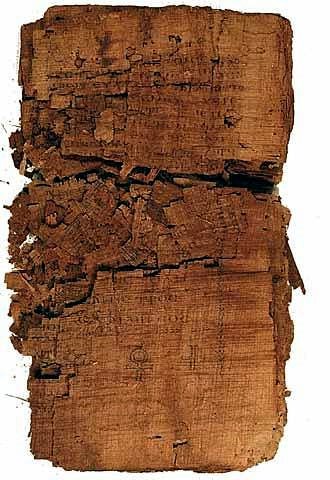
Though the manuscript was made public this week, its discovery dates back to mid 70's when some Egyptian peasants found it by chance in a limestone tomb at Al-Minya, on the banks of the Nile Papyrus was smuggled out of Egypt and stayed for nearly two decades kept in a bank in Long Island, New York, no one recognized the importance of the discovery had not yet been tested for dating. But in 2002 it bought the Swiss foundation Maecenas Foundation for Ancient Art, which funded the restoration of the papyrus and reached an agreement with the National Geographic Society and the Waitt Institute for Historical Discovery of California.

Analysis of Carbon-14 dating the manuscript around the year 300 and, although it is written in Coptic, the ancient language of Egyptian Christians, historians believe that is a translation of a Greek text of the year 187. The Treaty Against the heresy of Bishop Irenaeus of Lyon published in the year 180 and mentioned the existence of a Gospel of Judas Iscariot who told, in the words of Irieno de Lyon, "the secret account of the revelation that Jesus spoke in conversation with Judas Iscariot, one week before the Passover. "

The manuscript contains 26 pages of which only small fragments have been leaked showing a Judas too far from the image of "traitor" that provide the biblical texts. Some of the fragments screened are:
"You are the apostle cursed by all others. You, Judas, shall offer the sacrifice of this body of man I am covered (...) You will be the thirteenth, and you will be cursed by generations, and come to rule over them. "
" Y I said: 'Although this place does not do good, you're a true disciple of Jesus. " And he told them what they wanted to hear. And he delivered. This is the end of the Gospel of Judas ".
is not the first time it has been hypothesized that Judas acted on the advice of his master to sell it with a kiss, and that the apocryphal gospels point in this direction . However, this is the first ancient document defends this view. Is it plausible that say? Craig Evans, professor of New Testament at Acadia Divinity College in Canada, recalls that in the New Testament, Jesus asks appeals to two of his disciples on two occasions, and wondered whether his commitment to the Jewish authorities by Judas would not be a third. "It is possible that the submission of Jesus to Judas Iscariot was unknown to the other apostles." Moreover, as Elaine Pagels, a professor at Princeton University in the U.S., "the four Gospels accepted by the Christian canon tell the public acts of Jesus, but not private conversations."

Who wrote it is another mystery. Nowhere is said to be Judas, but that should not doubt his veracity, as the authorship of the Gospels of the New Testament is not assured. "Most texts are written on behalf of the disciples, but it is very unlikely that they were the authors, because it was written between about 50 and 80 years after the death of Jesus," as stated Marvin Meyer, professor Chapman University in California.

In any case, the full publication of the manuscript and the conclusions of his study in the coming weeks will shed more light on the find.

Monday, April 3, 2006

Compering Annual Days In Schools

In the shadow of Eva


What is the role of Lilith in the Christian Scriptures? The Old Testament mentions Lilith only once, however, the contradictions of Genesis, the appearance of Eve and the fall of Cain allow us to identify the influence of Lilith in many verses.
The following passage is the only explicit reference to Lilith. 34.14 Isaiah verse tells of the destruction of the city of Edom until being reduced to rubble and become a place of darkness where "wild cats and hyenas will meet, and satyrs shall meet, and also Lilith lie down there and find your resting place. " Notes footnotes avoided any reference to Lilith as Adam's first wife, but we show the classic iconography of Lilith we have looked primitive in earlier comments by stating: "The Hebrews believed that meant a diabolical being, in female form, lewd and night."

Some of the biblical scriptures that allow us to sense the hidden presence of Lilith are those on Genesis, which affords a remarkable contradiction. 1.27 The Genesis passage says: "And God created man in His own image, the image of God he created him, male and female created. And God blessed them, saying, be prolific and multiply, fill the earth and subdue it ". This passage shows that the creation of man and woman are made in the image and likeness of God, both equal to be created at the same time . However, the passage tells Genesis 2.21 " Yavhé Then God made the man fall into a lethargic sleep, and while he slept took one of his ribs, replacing meat in place, then, from the rib taken God formed Yavhé the woman and brought her to the man, who said, this is bone of my bones and flesh of my flesh, she shall be called woman, because the man has been taken. " Especially revealing is the statement of Adam "This is bone of my bones and flesh of my flesh." Was there another woman earlier that it was bone of his bone and was created from earth and dust?

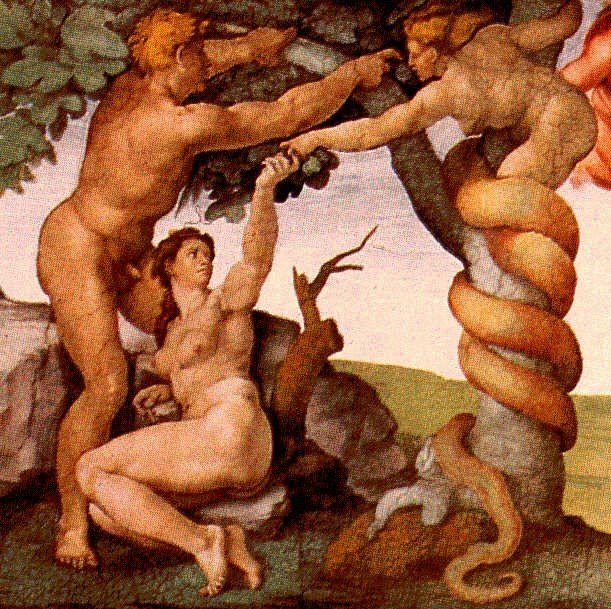
Another passage that illustrates the influence of Lilith in the biblical writings is the question of the fall of Eden. Genesis 3.1 says: " the serpent was more subtle than any beast of the field to do Yavhé God." In many classical traditions such as Sumerian or Assyrian the serpent was worshiped as a goddess of fertility, although subsequent Jewish iconography established a correlation between snakes and Lilith as a symbol de la decadencia y la expulsión del Edén. Las escrituras bíblicas retoman la iconografía hebrea de Lilith y la presentan en el jardín del Edén como una mujer mitad humana mitad serpiente enrroscada en el Árbol del Bien y del Mal tentando a Eva, la nueva mujer de Adán. Tal vez la iconografía más conocida sea la que ilustra la Capilla Sixtina del Vaticano y que reproduzco en el margen superior izquierdo.

En este punto, es llamativo resaltar que el Talmud hebreo señala a Samael, el ángel que se rebeló contra Yavhé y cayó derrotado al abismo, como esposo de Lilith. Ambos concibieron, durante su estancia el Mar Rojo, tres hijos o lilims -seres medio humanos, medio demoníacos-. De este Similarly, if we take as a starting point the Jewish tradition, the fall of Eden would be but a joint effort between Lilith and Samael (Lucifer in the Christian tradition) who acted as body and voice of the snake respectively. But what reasons have you both want the Edenic fall? Lilith awaited the arrival of Eva to avenge the curse of God that condemned her to see the death of hundreds of children every day, while Samael wanted to humiliate Yavhé's work since he was deported to the Abyss. But Lilith's Revenge is best understood if we analyze the figure of Cain.

Some authors such as Robert Graves linking figure of Cain in the blood, sacrifice, immortality and the presence of Lilith and Samael. After the expulsion of Adam and Eve in the Garden of Eden, she fathered a son as recounted in the Genesis passage 4.1: "The woman conceived and bore Cain, saying, I had a man thanks to the Lord." Graves points to the importance of Cain, the first homicide in biblical words, born after the acceptance of the forbidden fruit by Eve, and suggests that his birth would respond to the vengeance of Lilith to Eve dying to see their children Abel, as she saw her children die every day. Graves even goes further to ensure that Eve and Cain seríafruto Samael, not Adam since the passage Genesis 5.1 contains a list of the descendants of Adam but presciende of Cain and Cain lineage.

Anyway, one of the greatest enigmas of the story of Cain is why Yahweh cursed removing Adam and Eve Cain and defending the immortality of death?. After the murder of Abel, Genesis 4.12 passage recounts: "Cain shall go wandering and vagabond on earth ... and if anyone killed Cain, he will be avenged sevenfold." Only after the birth of his eldest son Enoch, Cain allowed Yavhé rest of his life wandering vagabond named Enoch built a city where he grew up Cain's lineage. But that is another story ...