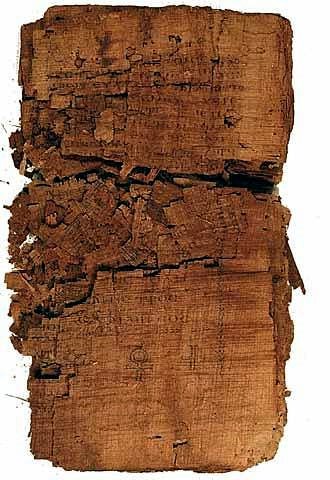
 The National Geographic Society and the Waitt Institute for Historical Discovery of California have surprised us with an archaeological discovery that, pending new data, some historians have been quick to compare in importance with Dead Sea Scrolls and Nag Hammadi.
 Though the manuscript was made public this week, its discovery dates back to mid 70's when some Egyptian peasants found it by chance in a limestone tomb at Al-Minya, on the banks of the Nile Papyrus was smuggled out of Egypt and stayed for nearly two decades kept in a bank in Long Island, New York, no one recognized the importance of the discovery had not yet been tested for dating. But in 2002 it bought the Swiss foundation Maecenas Foundation for Ancient Art, which funded the restoration of the papyrus and reached an agreement with the National Geographic Society and the Waitt Institute for Historical Discovery of California.
Analysis of Carbon-14 dating the manuscript around the year 300 and, although it is written in Coptic, the ancient language of Egyptian Christians, historians believe that is a translation of a Greek text of the year 187. The Treaty Against the heresy of Bishop Irenaeus of Lyon published in the year 180 and mentioned the existence of a Gospel of Judas Iscariot who told, in the words of Irieno de Lyon, "the secret account of the revelation that Jesus spoke in conversation with Judas Iscariot, one week before the Passover. "
The manuscript contains 26 pages of which only small fragments have been leaked showing a Judas too far from the image of "traitor" that provide the biblical texts. Some of the fragments screened are:
"You are the apostle cursed by all others. You, Judas, shall offer the sacrifice of this body of man I am covered (...) You will be the thirteenth, and you will be cursed by generations, and come to rule over them. "
" Y I said: 'Although this place does not do good, you're a true disciple of Jesus. " And he told them what they wanted to hear. And he delivered. This is the end of the Gospel of Judas ".
is not the first time it has been hypothesized that Judas acted on the advice of his master to sell it with a kiss, and that the apocryphal gospels point in this direction . However, this is the first ancient document defends this view. Is it plausible that say? Craig Evans, professor of New Testament at Acadia Divinity College in Canada, recalls that in the New Testament, Jesus asks appeals to two of his disciples on two occasions, and wondered whether his commitment to the Jewish authorities by Judas would not be a third. "It is possible that the submission of Jesus to Judas Iscariot was unknown to the other apostles." Moreover, as Elaine Pagels, a professor at Princeton University in the U.S., "the four Gospels accepted by the Christian canon tell the public acts of Jesus, but not private conversations."
Who wrote it is another mystery. Nowhere is said to be Judas, but that should not doubt his veracity, as the authorship of the Gospels of the New Testament is not assured. "Most texts are written on behalf of the disciples, but it is very unlikely that they were the authors, because it was written between about 50 and 80 years after the death of Jesus," as stated Marvin Meyer, professor Chapman University in California.
In any case, the full publication of the manuscript and the conclusions of his study in the coming weeks will shed more light on the find.


0 comments:
Post a Comment